Get the £7,500 government grant with Thermly.*
Discover the benefits, personalised for you – it only takes about 90 seconds!
*
Eligibility criteria apply

We give you personalised information, make sure you get right installer for your needs (all fully checked and certified).
Get your free report
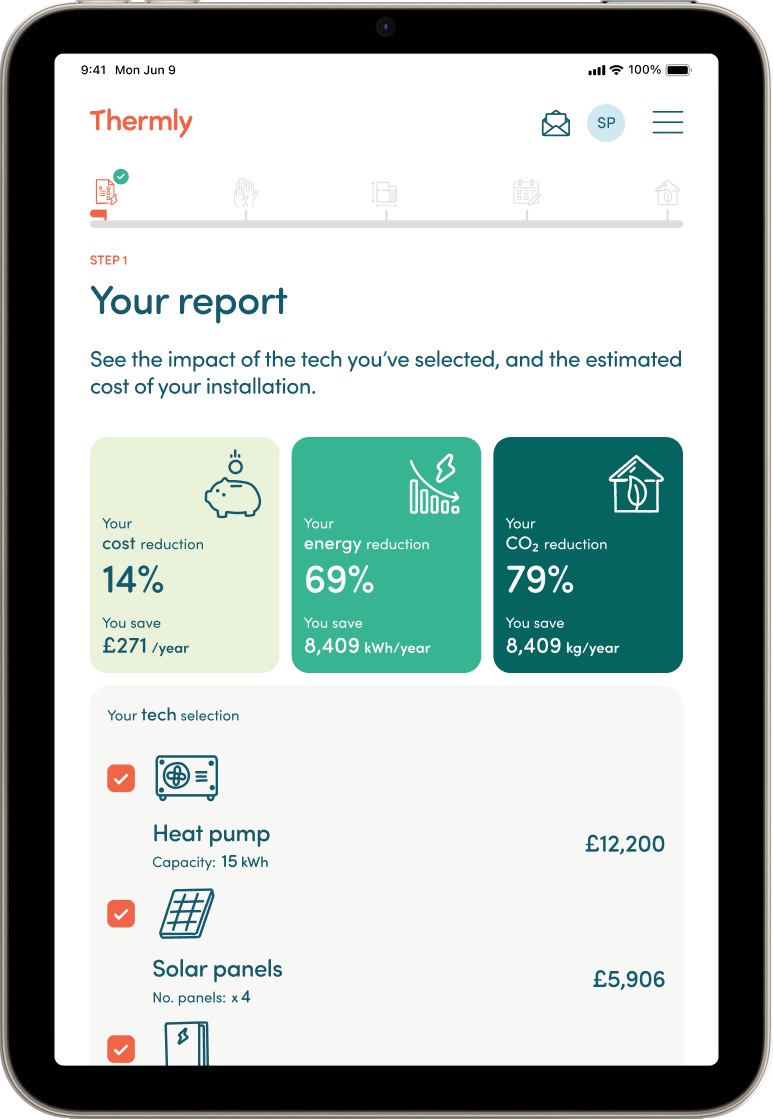
Complete a few, quick questions to generate your Thermly report. This will give you an estimate of the cost of your installation, and help you understand the impact of your choices on your home.
0


0
0
0

Confirm your details
At this stage, if you’d like an even more accurate estimate, you’ll have the option to provide more detailed, specific information about your home via your Thermly account. Once you’re ready to move forward, we’ll just need to confirm your address and contact details.
2
0
0
0

Compare installers
We'll connect you with up to x3 installers in your area who can supply your tech package. Each one will provide a free estimate of their costs, which you’ll receive in your account, presented in an easy to compare format. If you decide if you want to proceed, simply select the one that suits you best.
3
0
0
0

Survey
Having selected your installer, book a free home survey. The survey generally takes a couple of hours and will allow the installer to provide you with a final quotation for your chosen package, alongside all the relevant documentation and calculations required by the Microgeneration Certification Scheme (MCS).
4
0
0
0

Contract signing
Once any necessary finance arrangements are in place, contracts are signed in your account and you'll have a full record of what's happened and when. You still have a cooling off period of 2 weeks, but you can choose to waive this - entirely it's up to you.
5
0
0
0

Pay your deposit
After the cooling off period the installer makes an application to the power network, and applications for any applicable grants are made, at which point your deposit becomes due. You pay the deposit to Thermly, then we arrange payment to your chosen installer to purchase the equipment and materials required for your installation.
6
0
0
0

Book installation
You'll receive an email inviting you to book an installation date via your Thermly calendar. Installation can take up to 10 days (depending on the complexity) although typically it’s fewer.
7
0
0
0

Completion & Aftercare
The installer will walk you through everything – how to use, manage and control your system. Once completed and your final balancing payments are made, you’ll be able to download all your warranty documentation. You’ll also get a reminder when any servicing is due.
8
0
0
0

1
0
0
0
2
0
0
0
Compare installers
Compare installers
2
0
0
0
3
0
0
0
Survey
Survey
3
0
0
0

4
0
0
0
Installation
Installation
4
0
0
0
5
0
0
0
Completion & Aftercare
Completion & Aftercare
5
0
0
0
1
0
0
0
2
0
0
0
Compare installers
Compare installers
2
0
0
0
3
0
0
0
Survey
Survey
3
0
0
0
4
0
0
0
Installation
Installation
4
0
0
0
5
0
0
0
Completion & Aftercare
Completion & Aftercare
5
0
0
0
Compare installers
2
0
0
0
Survey
3
0
0
0
Installation
4
0
0
0
Completion & Aftercare
5
0
0
0
The Thermly platform is free to use, and it’ll only take 90 seconds to get the info you need.
Ready to go? Click the button below to get started. If you'd like to find out more about Thermly and green energy tech, visit our Info hub.

Through the Boiler Upgrade Scheme, you can apply for a grant to cover part of the cost of replacing fossil fuel heating systems with a heat pump.
This scheme is open to people in England and Wales who own the property they’re applying for (including if it’s a business, a second home, or a property you rent out to tenants).
Check the requirements below to make sure that you are eligible to receive the £7,500 grant. Bear in mind that air-to-air heat pumps are also eligible, but at the much lower rate of £2,500.




All Thermly MCS-certified installers offer annual maintenance packages for their installations – and it’s a always requirement of the product warranty that they are regularly maintained in line with manufacturer’s recommendations. It is very rare that installers will offer maintenance packages for other installers’ installations, and if you are in that boat (and unable to get your system maintained by the original installer) you would be best off contacting the manufacturer of the system for further support. Please note we do not, and nor do our installers, offer maintenance for systems they have not themselves installed.
There are a couple of ways to go about this. There is the formal Retrofit Assessment route, which we would definitetly recommend if you’re after a full overview of the complete spectrum options available to you. This would include insulation measures like loft, cavity and solid wall insulation, through to replacement windows, upgrading heating systems and applying other renewables. It’ll typically cost you about £600, and you can find out more here: What is a PAS 2035 Retrofit Assessor? - Retrofit Academy. If, however, you’re just after a heat pump, solar panels or battery, then you can arrange a survey for these technologies through certified and trusted installers, and without the upfront cost.
That’s an easy one – but it does depend on your home. Head here, and in about 90 seconds you should have an answer personalised for your home: https://platform.thermly.co.uk/
Yes – that’s what Thermly is here for. Well, provided you want heat pumps, solar panels, batteries, or any combination thereof. We’re rapidly growing, so we’re not covering every area with every technology just yet, but press on and get a free and personalised estimate of the cost of these technologies for your home. These will be refined once you go forward to survey – at which point al of the real detail is worked out and a final quote provided.
We strongly recommend that when you install a heat pump, you should have it done by full certified installers – which should include Microgeneration Certification Scheme (MCS) certification – who have lots of design and installation experience with the products they specify, are fully insured and are independently checked. Thermly’s network of installers have been through a robust process of assessment and checks to ensure they are competent, capable, local and can deliver the quality of installation you need. Once you’ve been through our quick assessment process, you will be able to see which of our installers is local to you, and then connect to them with confidence.
Well they could try, but you won’t get the government grant and there’s no guarantee it will work. We only engage local, fully Microgeneration Certification Scheme certified installers. We vet every installer on the Thermly platform and they need to demonstrate proven competency on the specific heat pump products they propose to install (i.e. manufacturer accreditation). We don’t let just anyone on the platform, just as you wouldn’t let anyone into your home.
Yes. Households can currently get a grant of £7,500 towards the cost (ch-ching!). The installer will apply for this for you if you decide to go ahead.
The Government wants to encourage homeowners to install a heat pump. Since April 2022 it has been offering a range of grants for an air source or ground source heat pump, and even better, these grants went up on 23rd October 2023. The current scheme is running until 2027. You can get one grant per property – and it’s currently worth £7,500. These grants help with the upfront cost of installing a low carbon heating system and encourage us all to make our homes more environmentally friendly.
In addition to the grant support, your local authority may offer additional low cost finance solutions, and over time we’ll be able to recommend and refer you to potential providers. If there are local council solutions in your area, we’ll sign post you to them when you go through the Thermly platform.
They should be no more expensive to maintain than a standard heating boiler – and as with standard boilers they should be serviced regularly.
It depends on your circumstances (is the sitting-on-the-fence politician’s answer). It’s a requirement of the Microgeneration Certification Scheme (MCS) that accredited installers don’t promise any particular cost saving. What does it depend on? Well, how long have you got? How much you paid. How well it’s installed. The efficiency and quality of the system itself. How you use it. How you used your previous system. What your previous system was and the fuel it used. How energy efficient your property is. And so on. We’d like to say – “yeah, it’ll save you £X grand per year” - but we can’t. If you’re doing this now it’s because you see the long term value in futureproofing your home, because it reduces your environmental impact and because fossil fuels are so passe. If the Government gets their heads round the problem, and decouples electricity pricing from gas pricing, you’re much more likely to be quids in too. But we’re not the Government, so we can’t promise that either.
Heat pumps operate ideally at lower temperatures – when they can be more efficient because they don’t work so hard. If your home is well insulated, and doesn’t lose heat easily, then it’s easier to maintain internal temperatures. This enables your heat pump to be smaller. It’s not impossible to whack a massive heat pump into something akin to a two storey tent, but we wouldn’t recommend it! The smaller the heat pump, the lower the installation cost, and the lower the ongoing running cost.
You should allow a few days, depending on whether you’re having radiators and pipework replaced.
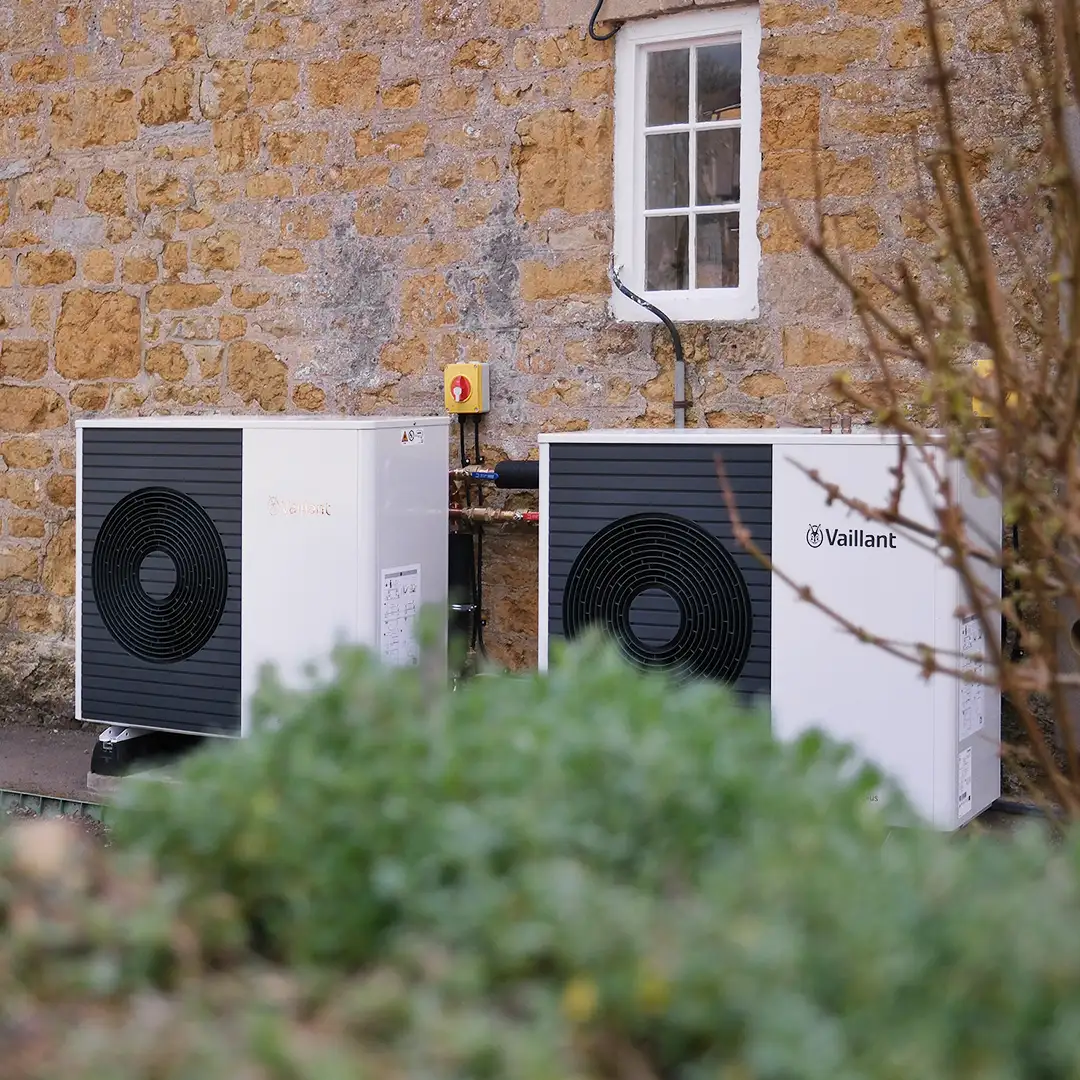
An air source heat pump converts outside air into heat, whereas a ground source heat pump absorbs heat from the ground. The latter needs a pipe dug into the ground – either horizontally using coiled pipework in trenches, or vertically using pipework in a borehole, whereas the former needs a heat pump fitted outside the house. Watch our %%link%%video%%link%% to understand more about how an air source heat pump is installed.
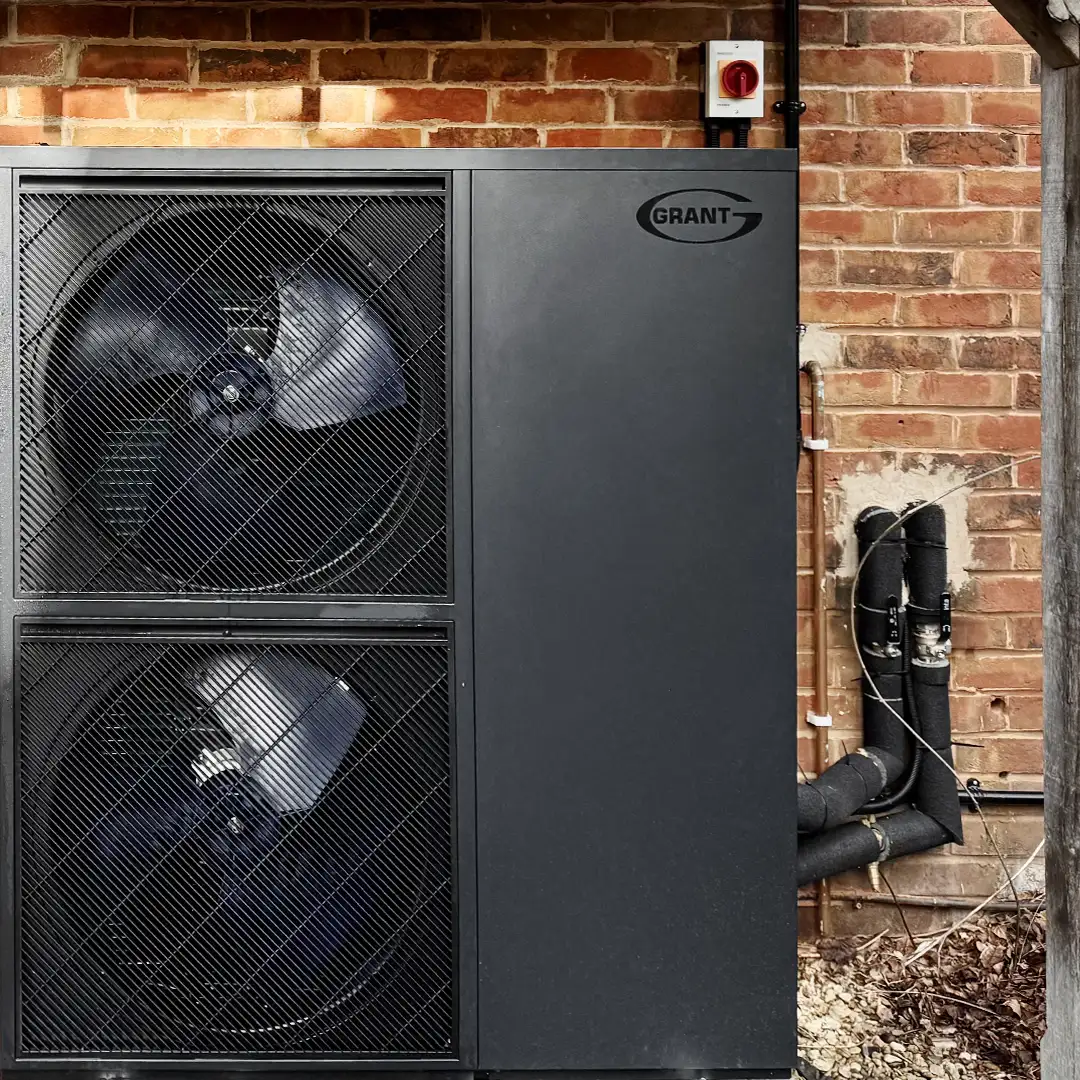
Beauty is in the eye of the beholder, and some people do like a big white box (we appreciate that’s probably not many). However there is a growing range of heat pumps and manufacturers are finally cottoning onto the visuals, with many more smarter looking external units coming onto the market.
As a minimum we would tend to recommend walls and loft are properly insulated before installing a heat pump. However, it may be the case that the costs of externally insulating a solid wall are prohibitive, in which case you’d need a bigger pump - and have to put up with the higher running costs. Our installers will talk the options through with you if you’re keen to progress.
__1-1__1080px.webp)
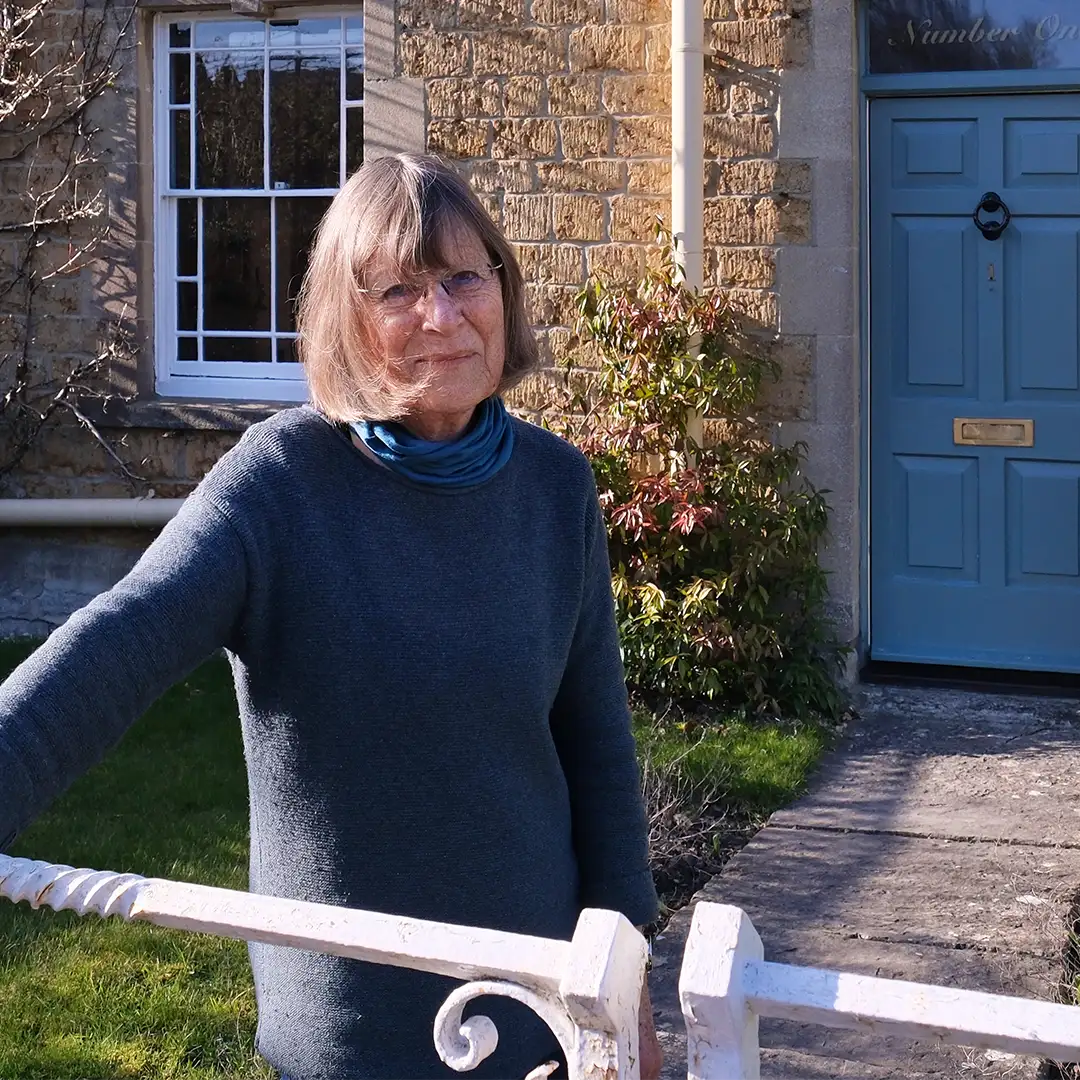
"We had been talking about it for a while, but actually it was when Thermly got in touch we finally just went for it. We had a great installer that came around and spent a few hours with us, explained absolutely everything, we had loads of questions, but [they] explained exactly how it would work."

"People are seeing the impact on weather systems and I think the next few years are critical. As individuals we should all be looking to reduce our carbon footprint....It’s futureproofing my home for me."
"I would encourage everyone to do it for climate change reasons…I think heat pumps are the solution."
At Thermly we believe it should be easier for people to make decisions that benefit their home, their community, and the planet.
We’re passionate about collaborative projects and initiatives that support this ambition, so we built the Thermly platform to do just that.

Provide tailored and independent advice specific to homeowners’ properties


Connect homeowners to our independently checked local, trusted installer network

Arrange necessary surveys and help access any available funding


Support homeowners through the whole process, including post-installation