There are a few things to be aware of when considering efficiency. In particular, heat pump efficiency depends on how hard each heat pump has to work to maintain a comfortable room temperature – the lower the ‘flow temperature’ (the temperature the water flows through your radiators), the greater the efficiency.
In a nutshell, however - heat pumps are a hugely energy efficient method for heating. Air source heat pumps are often more efficient than other heating systems and – designed and installed correctly - should produce more than three times the energy than they take in: 320%-350% efficient in fact! Why? Because they transfer heat rather than generate it.
It’s also useful to understand how heat pump efficiency is measured.
Heat pump efficiency is measured by its seasonal Coefficient of Performance (sCoP). This shows how efficiently it can heat your home under the best possible conditions. A CoP of 3.5, for example, means that for every unit of electricity used by the heat pump, 3.5 units of heat are generated for use within your home.
Let’s put this into perspective: direct electric heaters operate at 100% efficiency (1 unit of electricity produces 1 unit of heat), and brand-new A-rated gas boilers function at an efficiency of around 90%. For air source heat pumps, using the example above, the efficiency would be 350%.
It’s worth remembering that different seasons experience different temperatures, meaning the heat pump will work harder (and therefore be less efficient) at certain times of the year. When you read the manufacturers’ information on how efficient their heat pump is, look for the SCoP, or seasonal co-efficient of performance, which takes this into account.
Just to complicate matters, you may also see different SCoPs for different flow temperatures. The lower the flow temperature, the higher the SCoP. Better insulated homes can have lower flow temperatures as they experience lower heat loss. The heat pump doesn’t need to work so hard, so it’s more efficient.
When it comes to efficiency, a gas boiler is anywhere between 70% and 90% efficient, and that efficiency doesn't really change much when the outdoor temperature does. They're designed to pump high temperature hot water around your radiators. As mentioned above, it's a bit more nuanced with a heat pump. The following table shows how the efficiency of heat pump changes depending on the outdoor temperature, and how the system has been designed (flow temperature).
In every case a heat pump is more efficient than a gas boiler in producing space heating for your home:
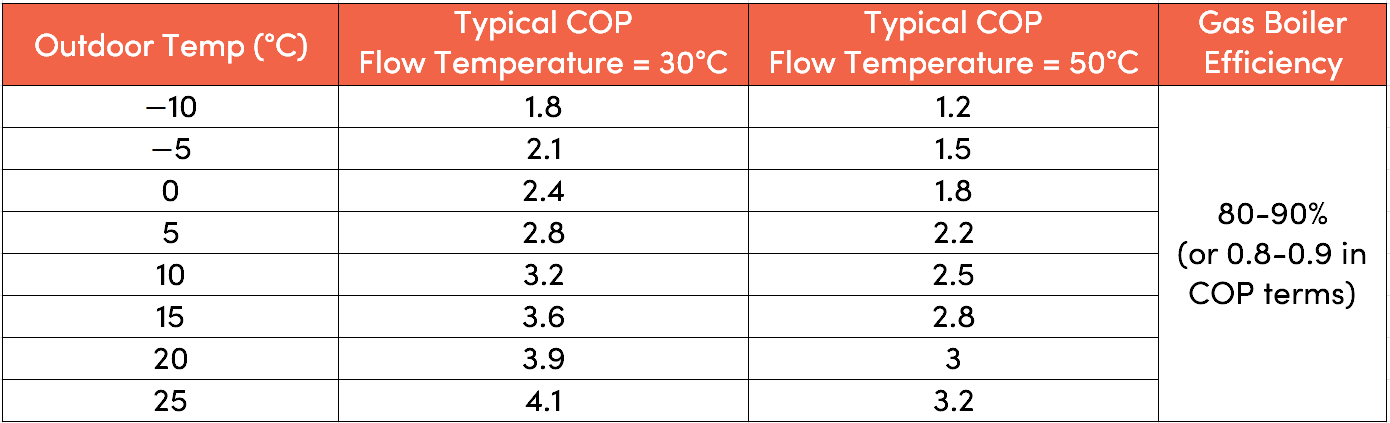
Yes - you can see by the table above that even in temperatures down to minus 10 degrees Celsius, the heat pump is operating more efficiently than the gas boiler. Heat pumps are also the dominant form of heating homes in Scandinavian countries, which are significantly colder, on average, than the UK. Efficiency does of course drop the colder it gets - as the heat pump needs to work harder to generate the heat needed to keep your home warm, but the system is still remarkably efficient.
3.5 should be achievable, 3.2 tends to be more common. Dropping below 3, especially given the disparity between electricity and gas prices (which have an impact on likely savings) isn't ideal. But, COPs can also exceed 4.0 depending on the system design, thermal performance of the property and the quality of the installation.
Hopefully this has helped provide some information to better understand the way heat pump efficiency is measured, and what it means - heat pumps are significantly more efficient than a traditional gas boiler heating system
To find out more about how Thermly can help you get a heat pump installed, head to: https://thermly.co.uk/heat-pumps
For more about who we are, visit: https://thermly.co.uk/about-us
Before you set up your account and continue your journey to a futureproofed home, just follow the links.


Yes, significantly more efficient. A brand-new A-rated gas boiler operates at around 90% efficiency — meaning 90p of every £1 of gas you buy is converted into useful heat. A heat pump typically operates at 300–350% efficiency, meaning every £1 of electricity you spend generates £3–£3.50 worth of heat. As the electricity grid becomes greener and prices become more competitive, this advantage will continue to grow.
Yes, air source heat pumps are designed to operate efficiently in temperatures as low as -15°C to -20°C, well below anything typically experienced in the UK. Their efficiency does reduce as outdoor temperatures drop; a heat pump with a CoP of 3.5 at 7°C might have a CoP of (say) 2 at -5°C, but they continue to heat your home effectively throughout a typical UK winter. Ground source heat pumps are even less affected by cold air temperatures because they draw heat from the ground, which stays at a relatively stable 8–12°C year round in the UK, regardless of air temperature.
Like any heating system, a heat pump's efficiency can reduce slightly with age if it is not properly maintained. However, with annual servicing, which involves checking refrigerant levels, cleaning filters, and inspecting the compressor, a heat pump should maintain close to its original efficiency for 15–20 years or more. A correctly designed and well-maintained heat pump should deliver consistent efficiency throughout its working life.
Insulation has a direct and significant impact on heat pump efficiency. A better-insulated home loses heat more slowly, meaning the heat pump does not need to work as hard to maintain a comfortable temperature. It can also mean that a smaller heat pump is needed, compared to a similar house with less insulation. A well insulated home with lower heat loss allows the system to run at a lower flow temperature, the temperature at which water circulates through your radiators, and lower flow temperatures produce higher CoP figures. For example, a heat pump running at a 45°C flow temperature might achieve a CoP of 3.5, while the same heat pump running at 55°C might only achieve 2.8. This is why the survey process assesses your home's insulation levels - and therefore heat loss - before sizing and designing heat pump system.
A good CoP for an air-source heat pump in UK conditions is 3.5 or above, meaning it produces at least 3.5 units of heat for every 1 unit of electricity it consumes. Well designed and installed heat pumps should achieve this level. When comparing models, look for the SCoP (Seasonal Coefficient of Performance) rather than the peak CoP, as SCoP reflects average efficiency across a full heating season, including the coldest months, giving you a much more realistic picture of real-world running costs.